More than 15 years of experience
A reliable contractor

Separation of reinforcement from concrete
In the recycling process, it may be necessary to separate the reinforcement from the concrete. This procedure is performed for the rational use of materials remaining after the demolition of structures and buildings. Separation provides the possibility of secondary use of concrete rubble and recycling of metal elements of reinforced concrete products. You can order recycling services from the company “Forest-Ukraine”. The price for separating reinforcement from concrete remains acceptable for all our customers.
Features of separation of reinforcement from concrete
The specifics of the procedure for separating reinforcement from concrete vary depending on the type of structure and construction conditions. This process is quite dangerous, therefore, appropriate safety standards and regulations are applied when performing such tasks.
Concrete and reinforcement are strong materials, so special mechanisms are used for separation. This is powerful equipment that helps to separate materials, even those of high strength and considerable dimensions.
Why is the process of separating rebar from concrete important?
The separation of reinforcement from concrete during demolition, liquidation, or reconstruction of a facility is of great importance due to the following advantages:
- The resulting materials can be reused. Iron is melted down into other products, and concrete is crushed and can be reused in construction.
- Economic benefits: The materials obtained during recycling can be sold for a profit. If construction is planned in the future, the company can reuse these materials, reducing costs.
- Environmental aspect: When recycling, resources are used more efficiently, which reduces the negative impact on the environment.
Отже, відокремлення металу від бетону є важливою процедурою, яка дає змогу отримати додаткову економічну вигоду, а також покращити екологічні показники.
Stages of the separation process
Separation of reinforcement from concrete in Ukraine is performed qualitatively and quickly. The following methods are used:
- Mechanical separation. This method involves the use of mechanical tools, cutting and grinding devices. This approach is important for separating concrete from reinforcement.
- Thermal separation. Heat is used to act on the concrete. This requires special gas burners and other heating equipment. This allows the concrete to be heated to critical temperatures to make it easier to separate the reinforcement.
- Chemical separation. Chemical solvents or reagents affect the characteristics of the concrete or the reinforcement itself to facilitate separation. However, the use of chemical solvents requires compliance with personal safety measures.
Several methods can be used at once. The choice of strategy is based on the performance of the structure and reinforced concrete elements. This helps to perform the separation with minimal time and resource consumption.
Environmental aspect of separating reinforcement from concrete
Separating reinforcement from concrete in reinforced concrete structures has a positive impact on the environment. This is due to the following:
- Waste reduction. Separating reinforcement allows you to save metal rods that can be reused. This reduces the need for new reinforcement and helps reduce the need for new production. Materials are used quite efficiently and waste is reduced.
- Simplifying the recycling process. The separation process helps facilitate the recycling of reinforced concrete structures, which has a positive impact on the environment by reducing the area of landfills for the disposal of such construction waste.
- Possibility of using recycled concrete. Concrete separated from metal is crushed by special crushers and can be used as secondary crushed stone during the construction of other objects. This allows to reduce the consumption of natural resources.
- Reducing energy consumption. Separating reinforcement helps reduce energy consumption associated with the manufacture and processing of new building materials. Reducing energy consumption helps reduce harmful emissions into the atmosphere.
Given these aspects, separating reinforcement from concrete can help reduce waste, environmental pollution, and energy consumption, which has a positive impact on the environment.
Our projects
View all our works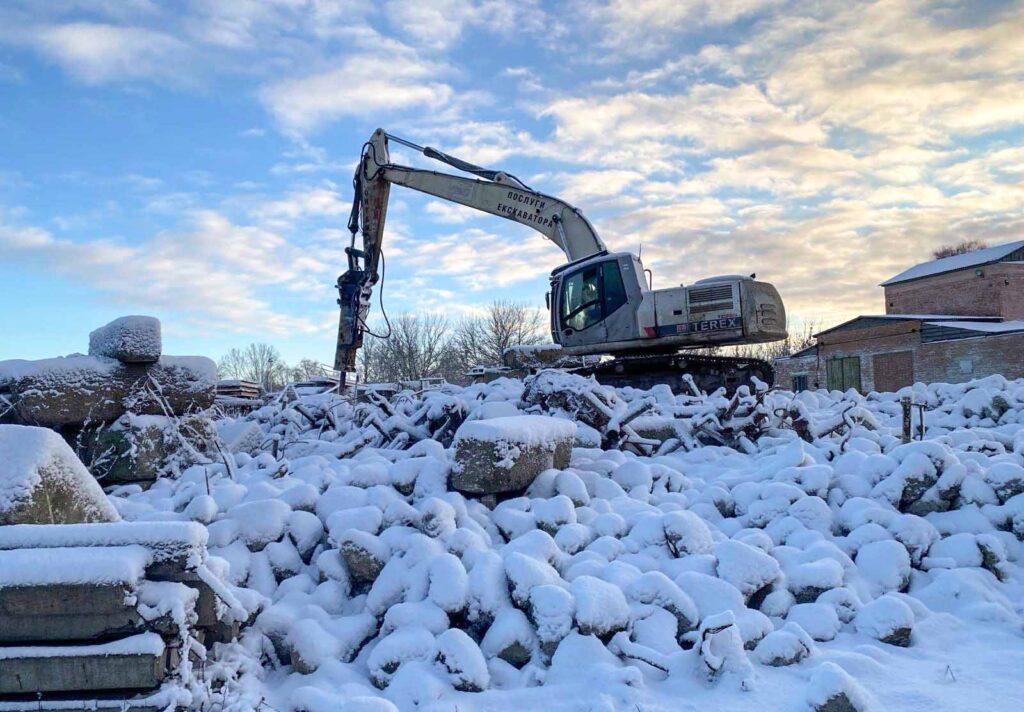
Crushing of construction waste
Let's discuss your project
Thank you for your request
Frequently asked questions
What is needed to calculate the cost of dismantling?
To accurately calculate the cost, we need to obtain basic information about the object. In most cases, it is enough:
photo of the building from the outside (from all sides) and from the inside
technical passport or project (if available)
height of the building and number of floors
type of foundations (monolithic, prefabricated, pile, etc.)
approximate distance of transportation of construction waste
The more complete the initial information, the more accurate the calculation.
In more complex cases, we go to the object to inspect and prepare a detailed estimate.
What is more profitable: complete dismantling or partial dismantling with preservation of structures?
In practice, dismantling with preservation of structures almost always turns out to be more expensive.
This is due to the fact that:
a significant part of the work is performed manually, without the use of heavy machinery
the execution time increases
the risks for workers and structures increase
In addition, most used materials already have a significant degree of wear or have exhausted their resource, so their further use or sale is not always economically feasible.
In many cases, complete dismantling with subsequent processing of materials (for example, into secondary crushed stone) is a more profitable and safe solution.
What to do with construction waste after dismantling?
During dismantling, we immediately perform rough sorting of materials:
metal is separated and sent for recycling
concrete, brick and other mineral materials – separately
wood, plastic and other waste – separately
Furthermore, several options are possible:
Transportation to a landfill – a standard solution, but involves additional costs for disposal
Recycling of materials – we crush part of the concrete and brick into secondary crushed stone, which:
is used for backfilling, roads, preparation of foundations
can be implemented
We help you choose the best option to minimize the client’s costs.
Do you dismantle buildings damaged by hostilities?
Yes, we have experience in performing dismantling work on objects damaged as a result of war.
Such objects require a particularly careful approach, as they often have:
emergency and unstable structures
partial collapses
increased level of danger for personnel
Before starting work, we necessarily conduct an inspection, assess the technical condition of the building and develop a safe dismantling technology.
If necessary, we provide:
development of a PVR in a short time
phased dismantling with risk minimization
sorting and removal of construction waste
We work throughout the territory of Ukraine (except for zones of active hostilities) and are ready to respond promptly to such objects.
Is a project (PVR) needed for the dismantling of a building?
Yes, in most cases, the implementation of dismantling works requires the development of a work execution project (PVR).
We develop PVR in a short time – usually within 2-3 working days.
The document takes into account the dismantling technology, safety, sequence of work and organizational solutions.
Our company provides full support:
preparation of all necessary documentation
maintenance of executive documentation
work with VAT and official closing of volumes
That is, the client receives not only work, but a completely closed process in terms of documents and reporting.
Do you work throughout Ukraine?
Yes, we perform dismantling work throughout the territory of Ukraine, except for regions where active hostilities are ongoing.
We have our own fleet of machinery and equipment, which allows us to quickly:
mobilize a team
relocate equipment
start work in a short time
Thanks to this, we work effectively both on local sites and on large projects in different regions of the country.